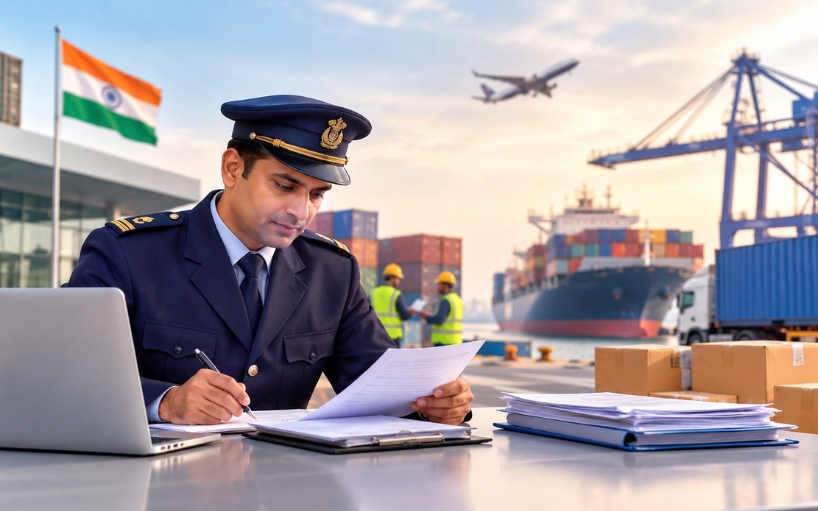
Introduction
International trade involves much more than moving cargo from one country to another. Importers and exporters must comply with customs regulations, submit the required documentation, complete customs procedures and coordinate cargo movement before goods can reach their final destination.
This is where a Customs Clearance Agent plays an important role.
A customs clearance agent helps importers and exporters coordinate customs-related procedures for their shipments, including documentation, electronic filing, assessment-related processes, queries and cargo release formalities.
In India, customs processes are increasingly handled through digital systems such as ICEGATE, where documents and customs-related transactions are electronically processed. ICEGATE supports filing and processing of documents such as Bills of Entry and Shipping Bills.
For businesses involved in regular international trade, working with an experienced customs clearance professional can help coordinate the customs component of the overall logistics process.
What Is a Customs Clearance Agent?
A Customs Clearance Agent assists importers and exporters with the procedures required to clear goods through customs.
The role can include:
- Preparing and coordinating customs documentation
- Filing customs-related documents
- Supporting import clearance
- Supporting export clearance
- Coordinating with customs authorities
- Responding to customs queries
- Coordinating examination-related requirements
- Supporting assessment and duty-related procedures
- Coordinating cargo release
- Communicating shipment status to clients
- Coordinating with freight forwarders, shipping lines, airlines and other logistics stakeholders
In India’s customs ecosystem, a Customs Broker can file Bills of Entry and Shipping Bills on behalf of clients through ICEGATE, subject to the applicable regulatory framework.
Therefore, when a business searches for a Customs Clearance Agent in India, it is generally looking for professional support to manage the customs component of its import or export shipment.
Why Is Customs Clearance Important?
Customs clearance is a critical stage in international cargo movement.
An international shipment may involve several parties:
Importer/Exporter → Customs Broker → Freight Forwarder → Shipping Line/Airline → Port/Airport → Customs → Warehouse → Final Destination
If documentation is incomplete or information does not match across shipment documents, additional queries or processing requirements can affect cargo movement.
For this reason, customs clearance should be planned before the shipment reaches the port, airport or other customs location.
Proper preparation can help businesses reduce avoidable documentation issues and coordinate the shipment more efficiently.
What Does a Customs Clearance Agent Do?
The exact responsibilities depend on the shipment, commodity, customs location and applicable requirements. However, a customs clearance agent may assist with several important stages.
1. Documentation Preparation
International shipments require appropriate commercial and logistics documentation.
Common documents can include:
Commercial Invoice
Packing List
Bill of Lading
Airway Bill
Bill of Entry
Shipping Bill
Import Export Code-related information
Certificates and licences where applicable
Commodity-specific documents
Documents required by participating government agencies
ICEGATE’s published guidance identifies documents such as the Bill of Lading/Airway Bill, Commercial Invoice, Packing List and Bill of Entry among the relevant import/export documentation, with additional documents depending on the commodity and applicable requirements.
A customs professional helps coordinate the documentation required for the particular shipment rather than treating every shipment as identical.
2. Import Customs Clearance
When goods arrive in India, the importer must complete the applicable customs procedures before the goods can be released.
A simplified import flow can be represented as:
Cargo Arrival → Bill of Entry → Document Processing → Assessment/Examination Where Applicable → Duty Payment → Out of Charge → Cargo Release
ICEGATE provides electronic facilities for Bill of Entry filing and status-related processes.
A Customs Clearance Agent can coordinate the documentation and communication involved in this process on behalf of the importer.
3. Export Customs Clearance
Export shipments also require customs formalities before goods can be exported.
A simplified export process can involve:
Shipment Preparation → Shipping Bill → Customs Processing → Examination Where Applicable → Let Export Order → Port/Airport Handling → Export
ICEGATE’s electronic filing framework includes Shipping Bill filing and related processing for exporters and Customs Brokers.
The exact requirements can vary depending on the goods, export scheme, destination and applicable regulations.
4. Electronic Filing Through ICEGATE
India’s customs ecosystem uses digital systems for several customs processes.
ICEGATE provides electronic filing facilities for documents including Bills of Entry and Shipping Bills. Its current message-filing guidance also lists updated formats for customs electronic messages.
A customs professional therefore needs to coordinate not only physical documentation but also electronic submission and communication.
This makes accurate shipment information particularly important.
5. Handling Customs Queries
Customs authorities may raise queries during the processing of a shipment.
A query can require clarification or additional documentation depending on the circumstances of the consignment.
A Customs Clearance Agent can coordinate the response with the importer or exporter and help submit the required information through the applicable customs process.
The objective is to ensure that the response corresponds accurately with the shipment documentation and applicable requirements.
6. Customs Examination and Cargo Release
Depending on the shipment and applicable customs procedures, goods may undergo examination or other checks.
Once the applicable requirements are completed, the shipment can proceed toward cargo release.
For imports, ICEGATE’s published guidance refers to the Out of Charge (OOC) order following completion of the applicable examination and assessment process.
For exports, the customs process includes the Let Export Order (LEO) stage.
This demonstrates why customs clearance is closely connected with the physical movement of cargo.
Documents Required for Customs Clearance
The documentation required depends on the nature of the shipment, commodity, transaction and applicable regulations.
Common documents may include:
Document | Typical Purpose |
Commercial Invoice | Provides transaction and commercial details |
Packing List | Provides package and cargo details |
Bill of Lading | Used for sea cargo transportation |
Airway Bill | Used for air cargo transportation |
Bill of Entry | Import customs declaration |
Shipping Bill | Export customs declaration |
Certificates | May be required depending on the commodity |
Licences/Permissions | Required for certain regulated goods |
Other supporting documents | Depends on cargo and applicable requirements |
Businesses should verify the current requirements applicable to their specific shipment rather than relying on a generic document list.
Customs Clearance Agent for Import Shipments
Importers often require customs support from the point at which shipping documents become available until cargo is released.
An import customs clearance workflow can include:
Step 1: Review Shipment Documents
The agent reviews the available shipment information and supporting documentation.
Step 2: Classification and Declaration Support
Relevant shipment and commodity information is prepared for the applicable customs declaration.
Step 3: Bill of Entry Filing
The Bill of Entry is filed through the applicable customs electronic system.
Step 4: Customs Processing
The shipment proceeds through the applicable assessment, examination and documentation stages.
Step 5: Duty and Compliance Requirements
Applicable duties, taxes and other requirements are addressed according to the shipment.
Step 6: Cargo Release
Once applicable customs requirements are completed, cargo can proceed toward release and subsequent transportation.
Customs Clearance Agent for Export Shipments
Exporters also need to complete customs formalities before cargo leaves India.
An export clearance workflow may include:
Commercial Documentation → Shipping Bill → Customs Processing → Examination Where Applicable → Let Export Order → Cargo Loading → Export
A Customs Clearance Agent can coordinate the customs documentation and communication involved in the process.
This becomes especially important for businesses handling regular export shipments where documentation consistency and shipment scheduling are important.
Customs Clearance and Freight Forwarding: What Is the Difference?
Customs clearance and freight forwarding are related but they are not the same service.
Service | Main Role |
Customs Clearance Agent | Handles/co-ordinates customs-related documentation and clearance procedures |
Freight Forwarder | Coordinates transportation and logistics movement |
Shipping Line | Provides ocean transportation |
Airline/Carrier | Provides air transportation |
Transporter | Handles inland road movement |
Warehouse | Handles storage and distribution activities |
In many international shipments, these functions need to work together.
For example:
Exporter → Road Transportation → Customs Clearance → Port → Ocean Freight → Destination
A logistics provider capable of coordinating multiple stages can simplify communication between the different parties involved.
How a Customs Clearance Agent Can Help Importers and Exporters
Businesses generally work with customs professionals because international trade involves multiple compliance and documentation requirements.
A customs clearance agent can help businesses with:
Documentation Coordination
Ensuring the required shipment documents are prepared and submitted through the applicable process.
Customs Process Coordination
Managing communication and documentation associated with customs processing.
Import Clearance
Supporting the customs formalities required for imported cargo.
Export Clearance
Supporting export documentation and customs processing.
Query Coordination
Helping coordinate responses when customs authorities request clarification or additional information.
Cargo Release Coordination
Supporting the process through which cleared cargo moves toward the next stage of transportation.
Common Reasons Customs Clearance Can Take Longer
Customs processing times can vary depending on the shipment and circumstances.
Potential issues can include:
- Incomplete documentation
- Incorrect or inconsistent shipment information
- Missing supporting documents
- Commodity-specific regulatory requirements
- Customs queries
- Examination requirements
- Duty or tax-related issues
- Licences or permissions required for specific goods
- Coordination issues between logistics stakeholders
Not every delay is caused by the customs clearance agent. Customs processing involves multiple parties and government procedures.
This is why businesses should provide accurate documentation and shipment information as early as possible.
Customs Clearance for Different Types of Cargo
Customs requirements can vary considerably depending on the nature of the cargo.
Machinery and Industrial Equipment
Industrial machinery may involve detailed product specifications, invoices, packing information and applicable regulatory requirements.
Electronics
Electronic products may require additional documentation or compliance depending on the product category.
Pharmaceuticals
Pharmaceutical shipments can involve additional regulatory and documentation requirements.
Chemicals
Chemical imports and exports may require commodity-specific documentation and compliance depending on the substance.
Textiles
Textile shipments may involve product classification, commercial documentation and destination-specific requirements.
Automotive Components
Auto components can involve detailed product descriptions, classifications and commercial documentation.
A customs clearance agent must therefore understand that customs procedures are not identical for every commodity.
Customs Clearance at Ports and Airports
Customs clearance takes place through different customs locations depending on how cargo enters or leaves the country.
This can include:
- Seaports
- Airports
- Inland Container Depots
- Container Freight Stations
- Land Customs Stations
- Other authorised customs locations
ICEGATE provides digital facilities and status information across customs processes and locations.
For businesses moving cargo through Mumbai and Navi Mumbai, coordination between customs clearance, port operations, freight forwarding and inland transportation is particularly important because multiple logistics activities may need to be completed within the same shipment schedule.
Why Choose a Customs Clearance Agent in India?
International shipments require coordination between documentation, customs procedures and transportation.
An experienced customs clearance partner can help businesses establish a structured process for:
- Import shipments
- Export shipments
- Documentation
- Customs filing
- Query coordination
- Cargo release
- Freight forwarding coordination
- Port and airport cargo movement
- Inland transportation
For businesses with regular international shipments, having a consistent customs process can also make communication between internal teams, suppliers, freight forwarders and logistics providers easier.
Customs Clearance and End-to-End Logistics
Customs clearance should not be viewed as an isolated activity.
Consider an import shipment:
International Supplier → Ocean Freight → Indian Port → Customs Clearance → Cargo Release → Road Transportation → Warehouse
Or an export shipment:
Factory → Warehouse → Road Transportation → Customs Clearance → Port → Ocean Freight → International Buyer
In both examples, customs clearance is one component of a larger logistics chain.
This is why integrated logistics planning can be useful for importers and exporters.
How SMTP Group Supports Customs Clearance
SMTP Group provides customs clearance and logistics support for businesses involved in domestic and international cargo movement.
Its logistics services include:
- Customs Clearance Services
- Freight Forwarding
- Ocean Freight
- Air Freight
- Road Transportation
- Warehousing & Distribution
- ODC Cargo Transportation
- Door-to-Door Cargo Services
- Cargo Insurance
- Logistics Consultancy and Compliance Support
By coordinating customs clearance with freight forwarding and transportation services, businesses can manage multiple stages of their cargo movement through a more connected logistics process.
Conclusion
A customs clearance agent plays an important role in India’s international trade ecosystem by helping importers and exporters coordinate customs documentation and clearance procedures.
From Bill of Entry and Shipping Bill processing to documentation, customs queries and cargo release, customs clearance forms an important link between international transportation and domestic cargo movement.
For businesses involved in regular imports and exports, customs clearance works best when it is integrated with freight forwarding, ocean freight, air freight, road transportation and warehousing.
As international supply chains become increasingly interconnected, businesses need logistics partners that understand not only customs procedures but also the transportation and distribution activities surrounding them.
SMTP Group provides integrated customs clearance and logistics services to help businesses coordinate their import and export cargo movement.